Defining The Traits of a Maine Coon Cat: Genetic Background and the Breed Standard
- Tiffany

- Jan 12
- 4 min read
The Maine Coon, America's favorite and only native pure-bred cat. Two hundred years ago, Maine Coon cats were simply called “Maine Cats.” As you can surmise, the breed originated in the coastal regions of Maine, noted as far back as the 1800’s. While many legends abound, it is most likely that the early ancestors of the Maine Coon came via sea trade routes from Europe, according to The Cat Fanciers Association’s article on “America’s First Show Cat.” Coastal Maine had some of the largest shipbuilding ports at the time and pets of every variety were bought in from foreign ports by sea captains and mariners who loved their feline passengers. These cats eventually found their way to nearly all the coastal towns and intermingled with the local population, forming the genetic basis of the Maine Coon. Their early arrival lends a distinct sea salt flavor to the history and development of the breed.
Genetic Background of the Maine Coon
Geneticists have traced the Maine Coon roots to Norwegian Forest cats and Siberian cats, who mixed with the American Shorthair. Its most distinguishing traits, tasseled ear tufts, long bushy tail, padded snow shoes, and a double coat with the top layer being waterproof, evolved naturally in Maine's harsh, snowy Northern climate. According to a study published in Genomics in 2008, researchers tested genetic similarity across different breeds and regional feral cat populations to create a phylogeographical map (see image below). Genetically, the maine coon is most closely related to the feral American Shorthair population, with distant relation to Norwegian Forest Cats and Siberians.

The Breed Standard
The breed emphasizes a large, rugged, well-boned frame, long rectangular body, a square muzzle, tufted ears, and a shaggy coat. There is much debate about the differences between the American style maine coon and the European. Often cited is that American Maine Coons tend to have a softer, sweeter look while their European counterparts tend to look more on the wild, feral side. While there is an apparent difference, they are all maine coons that originate in America and it is not true that the American breed doesn't have a more feral look. In The Scratch Sheet publication of Spring 1993, Barbara Svetich, Boise Idaho, writes
"My guys are both brown mackerel tabbies; most of the time they are as sweetie-faced as can be, but they are quite capable of looking as feral as any wildcat when it strikes their fancy."
One of the American founding cats is Sonkey Bill of Heidi Ho cattery. Here you can see the more wild type of features that are attributed to the European style.

What To Look for in a Maine Coon
The breed standard, or Standard of Points, is a written description of key areas on how a maine coon should look. The following is descriptions and pictures from The TICA Breed Seminar in 2004, which demonstrates how the breed should appear. The Standard hasn't changed since 2004.
General- The Maine Coon is America's native longhaired cat and evolved as a working cat in a rural environment. The role is reflected in the muscular cat of rugged outdoor appearance with a characteristic weatherproof coat and the demeanor of a capable hunter.
Head- broad modified wedge. Size in proportion to the body. Slightly longer than wide. A distinct muzzle break can be seen under high, prominent cheekbones.

Profile (forehead to nose)- Gently curving forehead. Gentle concave curve at the bridge of the nose, flowing into a smooth nose line.
Faults- Profile: straight Roman nose, nose bump

Chin and muzzle (Nose to chin)- The muzzle should be square with a firm chin; the chin, upper lip, and nose leather should fall in a perpendicular line.
Faults- chin weak or receding, narrow, or a lack of depth, Prominent whisker pads

Ears- Large, tall ears, wide at the base and tapering to appear pointed at the tip. The outer base is set just slightly farther back than the inner base. The outer base is just above the level of the top of the eye. Outer edges have a very slight outward tilt that is not past one o'clock. Set fairly high on the head with the inner edge base no more than one ear's width apart.
Faults- Ears; very close, set straight up. Narrow bases. Wide set and/or flared

Eyes- Large, slightly oval, appear round when wide open. The outer corner of the eye points toward the outer base of the ear. Wide set. Can be any shade of green, gold, or copper. Odd or blue eyes are permissible in white cats and particolors.
Faults- eyes; slanted, almond-shaped. Flat tops on openings.

Body- Torso is large, long, substantial, rectangular, and equal in breadth from shoulders to hips. Broad chest, level back. Females may be noticeably smaller than males. Boning is substantial, musculature is powerful, and legs are medium in length to form a rectangular body.
Faults- Torso: narrow, short cobby body, or a fine bone structure

Tail- At least as long as the body. Wide at the base and tapering to a tip with full flowing fur.
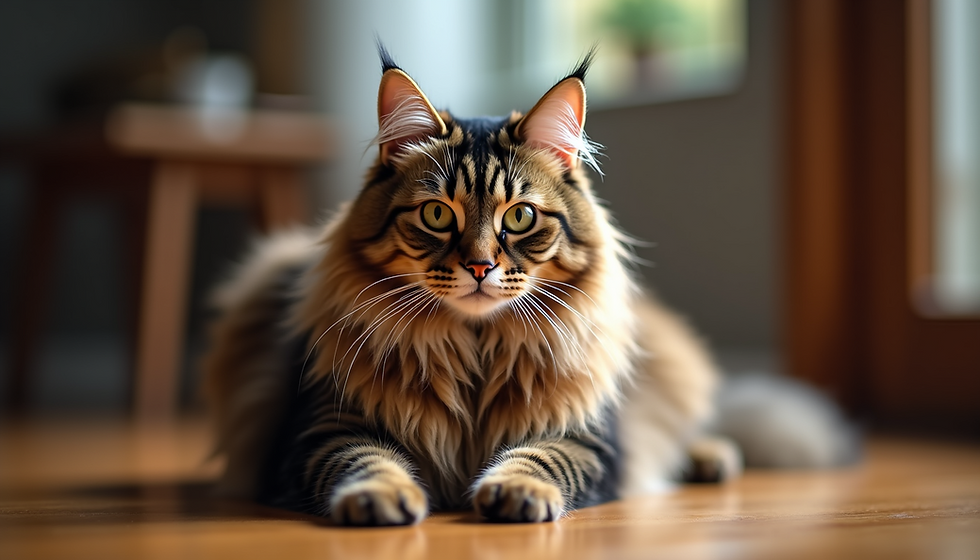
Coat- Uneven; shorter on the shoulders, gradually lengthening down the back and sides. Full long shaggy belly fur and britches. Texture is a all weather coat. A slight undercoat gives the coat body but still falls smoothly. Frontal ruff beginning at the base of the ears; heavier in males than in females. Ears are feathered and preferably tufted at the tips. Paws tufted, with long tufts emanating from under the paws, extending backward to create a snowshoe effect.
Faults- Coat; lack of a slight undercoat or belly shag. Overall, even coat length
Colour- The Maine Coon is recognised in a variety of solid colours, including white, tortoiseshell, tabby (classic and mackerel patterns) with or without silver; shaded and smoke colours; bicolour and particolour.
Faults- Colour; obvious lockets


Comments